Cigarette Butts Are Actually Plastic
Cigarette Butts Are Actually Plastic
They may look harmless, but cigarette butts have a dirty little secret.
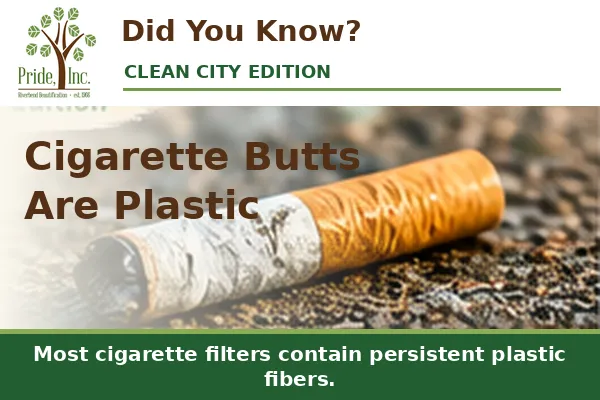
Most cigarette filters aren't made of cotton. They're made from cellulose acetate, a form of plastic.
When tossed onto sidewalks, into landscaping, or along roadways, these filters don't simply disappear.
They can remain in the environment for years, gradually breaking into smaller plastic fragments.
That's not the only concern.
Research has found that discarded cigarette butts can release harmful substances into surrounding
water and soil.
For a community working to protect its streets, parks, and rivers, cigarette litter deserves special
attention.
One tiny filter might not look like much, but thousands of them create a serious pollution problem.
THE TAKEAWAY: Always dispose of cigarette butts in designated receptacles. Our sidewalks
and waterways are not ashtrays.
SOURCE: U.S. EPA, Learn About Aquatic Trash — epa.gov/trash-free-waters/learn-about-aquatic-trash; Torkashvand et al.
(2020) — pubmed.ncbi.nlm.nih.gov/31563043/
